


The 2026 FIFA World Cup, co-hosted by the United States, Canada, and Mexico, represents a monumental shift in the history of global football. Expanding from the traditional 32-team format to a sprawling 48-team tournament, this iteration is not merely a festival of international sport—it is a statistical leviathan. With a grueling 104-match schedule spread across 16 host cities, the sheer volume of variables influencing on-pitch performance has grown exponentially. For football analysts, enthusiasts, and data-driven fans across Malaysia and the globe, this unprecedented scale demands a radical transformation in how accurate world cup predictions are formulated.
Historically, predicting World Cup fixtures heavily relied on human punditry. Experts based their forecasts on a combination of historical prestige, intuition, and limited recent form. However, the cognitive limits of traditional, human-led analysis are glaringly exposed when tasked with evaluating 48 distinct tactical systems. The upcoming tournament features elite European powerhouses clashing with emerging, highly unpredictable squads from Asia, Africa, and the Americas. When factoring in the unprecedented geographical and logistical complexities—such as tracking fluctuating metrics like player fatigue across distinct climate zones, the physiological impact of playing in the high altitude of Mexico City versus the humid, sea-level environment of Miami, and the toll of cross-continental travel—human analysis becomes mathematically inadequate.
This is the exact intersection where the paradigm shifts from opinion-based guesswork to empirical, data-driven forecasting. In the modern era of sports analytics, artificial intelligence and machine learning are no longer experimental concepts; they are the fundamental baseline for understanding the game. Machine learning algorithms can ingest, process, and analyze millions of data points per second, identifying underlying tactical patterns, historical anomalies, and performance trends that entirely escape human observation. Attempting to predict the trajectory of the 2026 World Cup without leveraging predictive algorithms is akin to stepping onto the pitch blindfolded.
At mescoreai.com, the immense complexities of the 2026 World Cup are met with a highly specialized, robust algorithmic infrastructure. The platform features a proprietary predictive modeling engine tailored specifically to decode this exact tournament. This advanced AI transcends basic historical results. It actively contextualizes vast datasets, combining historical national team performances with real-time variables such as squad rotational tendencies, biomechanical fatigue indexes, and nuanced tactical adjustments.
By deploying advanced machine learning protocols, mescoreai.com systematically eliminates the emotional bias that plagues traditional football fanbases. Instead of subjective opinions, the system provides users with mathematically verified, objective probabilities. Whether assessing an opening group stage match or a high-stakes knockout fixture, the platform stands as the ultimate technological bridge, transforming complex, chaotic tournament data into actionable, high-precision forecasts for the future of football.

The Algorithmic Engine: Custom-Tuned Datasets for the 2026 Tournament
At the absolute core of mescoreai.com lies a sophisticated algorithmic engine built with a singular, unyielding objective: decoding the highly complex landscape of the 2026 World Cup. A critical flaw in many generic sports prediction models is their over-reliance on club-level data. The tactical cohesion, daily training routines, and statistical outputs seen in a grueling 38-game European domestic season simply do not translate to the short, high-intensity, and often unpredictable format of international football. To solve this, the platform engineers its datasets with strict tournament-specific optimization. These custom models actively filter out the statistical noise generated by domestic leagues, isolating and prioritizing historical national team dynamics, recent international friendlies, and continental tournament performances (such as the AFC Asian Cup, UEFA Euros, and Copa América) to build a pure, highly accurate international profile for each of the 48 participating nations.
To generate mathematically sound and highly precise forecasts, the platform’s machine learning algorithms process an immense matrix of multi-dimensional data. The system systematically ingests comprehensive head-to-head metrics and historical encounters, but this analysis penetrates far beyond superficial win-loss records. It evaluates regional qualification performances across all global confederations—including the AFC, UEFA, CONMEBOL, CAF, and CONCACAF. Crucially, the system applies dynamic Elo rating adjustments and strength-of-schedule modifiers. This means the AI understands the contextual difference between a team dominating weaker opposition in a straightforward qualifying group versus a squad battling through a highly competitive “Group of Death.”
Furthermore, the 2026 World Cup introduces unparalleled physical and logistical demands. To account for this, the predictive engine integrates advanced injury and fatigue indexing. The algorithms computationally track the cumulative minutes each player has endured in their respective club seasons leading up to the summer tournament. This physiological data is then cross-referenced with the brutal logistical realities of the 2026 host cities. The AI accurately quantifies the biological tax of traveling across massive time zones—from the Pacific coast to the Eastern seaboard—and evaluates how drastic changes in climate and altitude will degrade a team’s high-intensity sprinting capabilities, pressing efficiency, and overall defensive shape in the crucial final 20 minutes of a match.
Perhaps the most significant competitive advantage of this algorithmic engine is the complete eradication of emotional bias. Football is an inherently passionate sport, and fans—from the mamak stalls in Kuala Lumpur to the grandstands across the globe—are frequently swayed by brand prestige, historical legacy, or media narratives surrounding superstar players. Human analysts might unconsciously favor a traditional powerhouse like Brazil, Germany, or Argentina, completely overlooking fundamental tactical flaws or aging squad dynamics.
The statistical modeling utilized by mescoreai.com is entirely blind to nostalgia and media hype. It operates strictly on quantitative, underlying metrics such as Expected Goals (xG), Passes Per Defensive Action (PPDA), field tilt, and progressive carrying distances. Its multi-layered neural networks are trained to recognize patterns in data, not the badge on the shirt. If a historically dominant team is mathematically underperforming in their transitional defense, the AI will relentlessly expose that vulnerability. By stripping away human sentiment, mescoreai.com offers its users objective, purely quantitative probabilities, providing a mathematically verified edge in understanding and predicting the 2026 World Cup.

Core Capabilities of mescoreai.com
Beyond theoretical data models and abstract algorithmic structures, mescoreai.com manifests its computational power through a highly intuitive, user-facing analytical platform. Processing billions of historical data points is only half the battle; the true value of this technology lies in translating that immense statistical weight into accessible, actionable insights for the users. The platform deliberately moves past archaic, descriptive statistics—such as simple possession percentages, raw shots on target, or basic pass completion rates—which often fail to articulate the true story of a football match. Instead, it delivers predictive, forward-looking metrics engineered to anticipate the exact trajectory of 2026 World Cup fixtures. By leveraging proprietary machine learning models, mescoreai.com offers three foundational pillars of predictive capability that provide users with an unparalleled analytical edge.
The first and most critical capability of the platform is its Precision 1X2 (Home Win, Draw, Away Win) forecasting matrix. Traditional forecasting methodologies often round off probabilities, providing vague, generalized assessments like “Team A is the heavy favorite” or “Expect a tightly contested draw.” mescoreai.com completely rejects this lack of specificity. The algorithms calculate win, draw, and loss probabilities down to the exact decimal point, rendering a mathematically precise confidence interval for every single group stage and knockout match of the 2026 tournament. For the analytical football community in Malaysia—a demographic well-known for its deep tactical understanding and rigorous appetite for statistical accuracy—this level of granularity is absolutely vital.
How is this decimal-point precision achieved? The central AI engine runs tens of thousands of Monte Carlo simulations for each individual fixture. By simulating the match under a massive variety of conditions—factoring in team form, tactical setups, historical efficiency, and even the referee’s historical card-issuing tendencies—the system generates a comprehensive distribution of potential outcomes. It then aggregates these simulated results to produce exact percentage probabilities. If the AI calculates a 43.7% chance of a home victory, a 28.1% chance of a draw, and a 28.2% chance of an away win, users receive those exact, unvarnished metrics. This precision allows users to identify statistical discrepancies and hidden value in the broader public perception, stripping away media narratives and focusing solely on the underlying mathematical reality of the fixture.
The second core capability delves into the most revolutionary and widely debated metric in modern football analytics: Expected Goals (xG). However, while most mainstream platforms use xG strictly as a post-match descriptive tool to analyze what should have happened based on chance quality, mescoreai.com utilizes a highly advanced, predictive xG framework. It projects future offensive output (Expected Goals For – xGF) and defensive resilience (Expected Goals Against – xGA) to forecast precise match scorelines and overarching goal margins, such as Over/Under thresholds.
The predictive xG models dissect the granular details of how national teams create chances. The system does not merely look at the volume of goals a team scores; it evaluates the mathematical quality and context of the chances they generate. It factors in complex variables such as shot location coordinates, assist type (e.g., through ball, defensive-splitting pass, set-piece delivery), the defensive pressure applied to the shooter (measured by defender proximity), and the specific phase of play (sustained possession vs. rapid counter-attack). Furthermore, the platform integrates Post-Shot Expected Goals (PSxG) to evaluate the shot-stopping capabilities of the goalkeepers involved. When analyzing a 2026 World Cup matchup between a possession-heavy European giant and a low-block, counter-attacking South American squad, the AI mathematically models the interaction between these contrasting stylistic frameworks. By running these advanced algorithms, the system can confidently project the exact scoreline distribution, highlighting the most mathematically probable final scores (e.g., predicting a 1-0 win with a 18.5% probability versus a 2-1 win with a 14.2% probability). This level of deep statistical insight completely redefines how users analyze attacking potential and defensive solidity on the global stage.
The final pillar of these core capabilities is perhaps the most technologically demanding and practically crucial: Dynamic Data Recalibration. The landscape of a World Cup match can alter dramatically in the pivotal 60 minutes leading up to kick-off. A star striker might fail a late fitness test during the warm-up, a manager might deploy a surprise back-five defensive formation to neutralize an opponent’s wingers, or a sudden torrential downpour in a host city could fundamentally change the pitch dynamics and ball speed. Traditional analysis simply cannot adapt to these late-breaking variables fast enough. Human pundits are often left scrambling to update their predictions based on hurried gut reactions.
At mescoreai.com, the machine learning models are continuously active and entirely dynamic. The very moment official starting XIs are announced, the system instantly ingests the new lineup data. If a key playmaker is unexpectedly benched, the algorithms immediately recalculate the team’s expected chance creation rate and adjust the 1X2 match probabilities in real-time. If there is a sudden tactical shift or formation change, the AI identifies the historical data associated with that specific structural setup and runs a fresh batch of thousands of simulations within mere seconds. This rapid, automated recalibration ensures that users are never relying on outdated, pre-match assumptions made days in advance. Instead, they are armed with the most current, mathematically verified insights exactly when it matters most—right before the referee blows the opening whistle. This continuous, real-time feedback loop guarantees that the predictive accuracy of mescoreai.com remains razor-sharp, adapting instantly to the chaotic, fluid, and unpredictable nature of the 2026 World Cup.
Algorithmic World Cup Predictions vs. Traditional Punditry
For decades, the global football forecasting landscape has been heavily dominated by the traditional punditry model. Across sports media, television panels, and expert columns—frequently consumed by passionate football communities in Malaysia and throughout Southeast Asia—predictions have largely relied on a combination of anecdotal evidence, subjective tactical observations, and intuitive “gut feelings.” While this traditional approach provides excellent entertainment value, it is fundamentally ill-equipped to handle the immense statistical complexity of the expanded 48-team 2026 World Cup. The modern sports ecosystem demands empirical rigor, and this is exactly where the sophisticated algorithmic modeling utilized by platforms like mescoreai.com decisively outclasses human analysis.
The primary divergence between these two methodologies lies in raw processing capacity. Human cognition has strict neurological limits. A top-tier football analyst might deeply study ten to fifteen recent matches leading up to a major tournament. Consequently, human predictions are universally plagued by cognitive biases, most notably “recency bias”—the tendency to over-index on a team’s or player’s most recent performance while ignoring larger, long-term statistical trends. Analysts might predict a resounding victory based on a single impressive friendly match, completely missing the underlying structural flaws of a squad.
In stark contrast, the artificial intelligence engine powering mescoreai.com operates on an industrial, computational scale. Algorithms do not suffer from memory fatigue or recency bias. The platform simultaneously evaluates tens of thousands of historical fixtures, processing millions of individual data points ranging from pass trajectories and defensive block coordinates to long-term xG (Expected Goals) rolling averages. When human pundits attempt to forecast a match, they mentally visualize one or two highly likely scenarios. Conversely, the predictive models at mescoreai.com run vast arrays of Monte Carlo simulations, plotting tens of thousands of mathematically possible outcomes onto a comprehensive probability distribution curve. This ensures that every potential anomaly, no matter how statistically improbable, is accounted for in the final 1X2 percentages.
Beyond sheer processing volume, algorithmic modeling excels in advanced pattern recognition, easily identifying tactical vulnerabilities that are entirely invisible to the human eye. Football is an inherently fluid, chaotic, and low-scoring game, which frequently leads human analysts into the trap of “outcome bias”—judging a team’s actual performance quality solely by the final scoreline. If a national team wins a group stage match 2-0 but conceded 3.5 Expected Goals and allowed the opposition 25 touches in their penalty area, traditional pundits might still praise their “defensive solidity” and “tournament resilience.”
The machine learning algorithms at mescoreai.com see straight through this statistical mirage. The AI identifies the data anomalies, recognizing that the team was mathematically outplayed, structurally porous, and only survived due to pure statistical variance or remarkably poor opposition finishing. By evaluating hidden metrics—such as a sudden drop in Passes Per Defensive Action (PPDA) intensity after the 70th minute, or a vulnerability to progressive ball carries in the defensive half-spaces—the AI uncovers the true tactical reality. If that “winning” team goes into their next 2026 World Cup fixture against a highly efficient attacking side, human pundits might back them to win again, but mescoreai.com will ruthlessly downgrade their probabilities based on their flawed underlying metrics.
Finally, the transition from punditry to algorithmic modeling completely eradicates the influence of media narrative and historical bias. The sports media landscape thrives on compelling storylines—narratives about a team’s “championship DNA,” “tournament pedigree,” or the perceived destiny of a superstar player on their farewell tour. These are abstract, unquantifiable, and ultimately useless metrics for accurately predicting football matches.
The analytical frameworks at mescoreai.com reject these narratives entirely. The platform’s algorithms operate with cold, calculated objectivity. They do not care how many World Cups a nation won two decades ago, nor do they factor in the commercial popularity of a team’s star striker. If a historically prestigious and highly favored national team possesses underlying metrics indicating a systemic flaw in their midfield build-up play, the AI will accurately reflect that weakness in the generated odds. For digital sports analysts and data-driven fans who want to look past the noise of sports television, relying on the algorithmic modeling provided by mescoreai.com ensures that every prediction is rooted strictly in mathematical reality, not media mythology.
Actionable Intelligence: How to Leverage mescoreai.com for 2026 World Cup Predictions
Understanding the complex algorithmic architecture behind artificial intelligence is fascinating, but for the practical football enthusiast and the analytical sports community in Malaysia, the ultimate question remains: how can this technology be utilized to gain a tangible advantage during the 2026 World Cup? Before exploring the strategic applications, it is essential to quantify the proven reliability of the platform. The predictive models driving mescoreai.com are not experimental concepts; they are validated systems backed by formidable performance metrics.
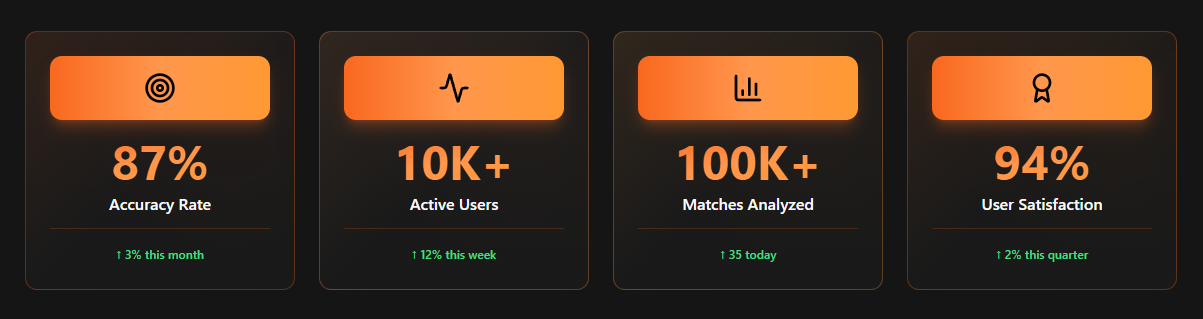
The platform’s algorithms have successfully processed an astonishing volume of historical data, having systematically analyzed over 100,000 matches. This relentless machine-learning iteration has resulted in a highly lucrative 87% accuracy rate across its forecasting modules. The consistency of these AI-generated predictions has rapidly cultivated a dedicated digital community, boasting more than 10,000 active users who rely on the system for daily match insights. Furthermore, the platform maintains an exceptional 94% user satisfaction rating, underscoring its immense value in the competitive sports analytics market.
Equipped with this level of mathematical certainty, users can leverage mescoreai.com through two primary strategic lenses during the upcoming global tournament:
1. Tactical Validation for the Football Purist For fans who study formations, transitional play, and managerial chess matches, the platform acts as the ultimate analytical companion. Instead of debating whether a high-pressing 4-3-3 formation will successfully dismantle a low-block 5-3-2, users can consult the AI to view the exact mathematical probability of that outcome. The system highlights statistical deviations, allowing users to understand precisely where a match might be won or lost—whether it is a vulnerability in the left half-spaces or a predicted drop in defensive intensity after the 75th minute. Additionally, the platform enhances the viewing experience by offering integrated Live Streaming capabilities, enabling users to watch the tactical adjustments unfold in real-time while simultaneously tracking the shifting algorithmic probabilities.
2. Data-Driven Decisions for the Analytical Fan For the demographic focused on sports probabilities and seeking a verifiable edge in the market, the platform transforms raw data into high-value opportunities. By comparing the AI’s razor-sharp decimal probabilities against broader public consensus or traditional market odds, users can easily identify “value alignments”—instances where the general public is heavily influenced by team popularity (e.g., heavily backing a famous European squad) while the AI accurately detects underlying statistical weaknesses. This ensures that every decision made during the 104-match marathon of the 2026 World Cup is completely devoid of emotional bias and grounded strictly in quantitative reality.

Unlocking the Algorithmic Advantage: A Step-by-Step Guide Transitioning from a casual observer to an empowered, data-driven analyst requires accessing the full spectrum of premium features on the platform. The architecture of mescoreai.com is designed for seamless onboarding, allowing users to unlock all predictions and advanced analytical dashboards within minutes. To gain unrestricted access to the AI engine, users must follow a highly streamlined, three-tiered integration process outlined on the platform:
STEP 1: Create a mescoreAI Account through the official registration portal.
STEP 2: Deposit a minimum of RM50/SGD50 in me88, which serves as the official integration partner.
STEP 3: Start Winning by utilizing the unlocked 1X2 probabilities, xG forecasts, and real-time match recalibrations.
By following these strategic steps, football enthusiasts across Southeast Asia can elevate their 2026 World Cup experience, leaving behind the outdated era of guesswork and stepping confidently into the future of mathematically verified sports forecasting.
The End of Guesswork: Why mescoreai.com is Essential for 2026
The 2026 FIFA World Cup is destined to be the most analytically complex sporting event in history. With 48 international teams navigating diverse climates, multiple time zones, and a grueling 104-match schedule, traditional forecasting methods are mathematically obsolete. In this modern era of sports, data superiority is no longer a luxury—it is the ultimate necessity for anyone looking to seriously analyze or predict tournament outcomes.
Platforms like mescoreai.com represent the absolute pinnacle of this technological evolution. By systematically eliminating human bias, leveraging massive tournament-specific datasets, and executing real-time algorithmic recalibrations, the system provides an unprecedented analytical edge. For football enthusiasts, tactical purists, and data-driven fans across Malaysia and the broader Southeast Asian region, stepping into this new era of sports analytics is highly imperative. Why rely on outdated guesswork when artificial intelligence offers empirical certainty?
For those ready to elevate their tournament strategy, there is no better time to test the immense capabilities of this platform. By leveraging the highly accurate ai world cup predictions available at mescoreai.com, fans and analysts can instantly transition from subjective speculation to mathematical certainty. Do not let the overwhelming complexity of a 48-team format dilute your analytical edge. Register an account today, unlock the premium data dashboards via the me88 integration, and start navigating the 2026 fixtures with unparalleled precision. Visit mescoreai.com now to experience the ultimate algorithmic advantage and transform how you conquer the world’s biggest football tournament.
FAQs (Frequently Asked Questions)
How accurate are AI football predictions for the World Cup?
he accuracy of artificial intelligence in football forecasting significantly outperforms traditional punditry due to its capacity to process vast datasets without emotional bias. Specifically, the advanced machine learning models utilized by mescoreai.com boast an impressive, historically verified 87% accuracy rate, built upon the rigorous analysis of over 100,000 matches. While football remains an inherently unpredictable sport, AI drastically narrows the margin of error by utilizing Monte Carlo simulations to calculate exact decimal probabilities for every conceivable outcome.
What specific data does mescoreai.com use for the 2026 tournament?
Unlike generic prediction platforms that incorrectly rely on domestic club statistics, the algorithmic engine powering mescoreai.com is custom-tuned strictly for international football. The system ingests multi-dimensional national team data, including historical head-to-head metrics, regional qualification performance (spanning AFC, UEFA, CONMEBOL, CAF, and CONCACAF), and dynamic Elo ratings. Furthermore, it accounts for the unique logistical challenges of the 2026 World Cup by mathematically tracking player fatigue indexes, cross-continental travel burdens, and the physiological impacts of playing in diverse altitudes and climates across the United States, Canada, and Mexico.
Can AI account for unpredictable events like red cards or sudden injuries?
While pre-match data cannot foresee a random red card occurring in the opening minutes, advanced AI manages these chaotic variables through a process called Dynamic Data Recalibration. The moment a major unpredictable event occurs—or when unexpected starting lineups are announced just 60 minutes before kick-off—the machine learning models at mescoreai.com instantly recalculate the match metrics. The system immediately runs fresh, high-speed simulations based on the new on-pitch reality (e.g., how a specific team historically defends with 10 men), providing users with updated, real-time probability shifts to make rapid, mathematically sound decisions.
Disclaimer: This review is intended for informational and entertainment purposes only. We do not encourage or promote online gambling. Always ensure that you comply with your local laws and gamble responsibly if you choose to do so.
If you believe any part of this review is inaccurate, misleading, or would like to share your experience with this platform, please click here to submit your feedback or report a concern. We value transparency and user input in maintaining review accuracy.

Author - Anthony Tang
Navigating the vibrant and rapidly evolving digital landscape of Southeast Asia for more than ten years, Anthony Tang has become a distinguished voice in the region’s tech and entertainment industries. As a content strategist and analyst, his work deciphers complex user behaviour and consumer trends, particularly at the nexus of interactive entertainment (such as gaming) and the integration of emerging fintech solutions.